Whirlpool Wall Oven Showing a Code: What to Note Before Reset
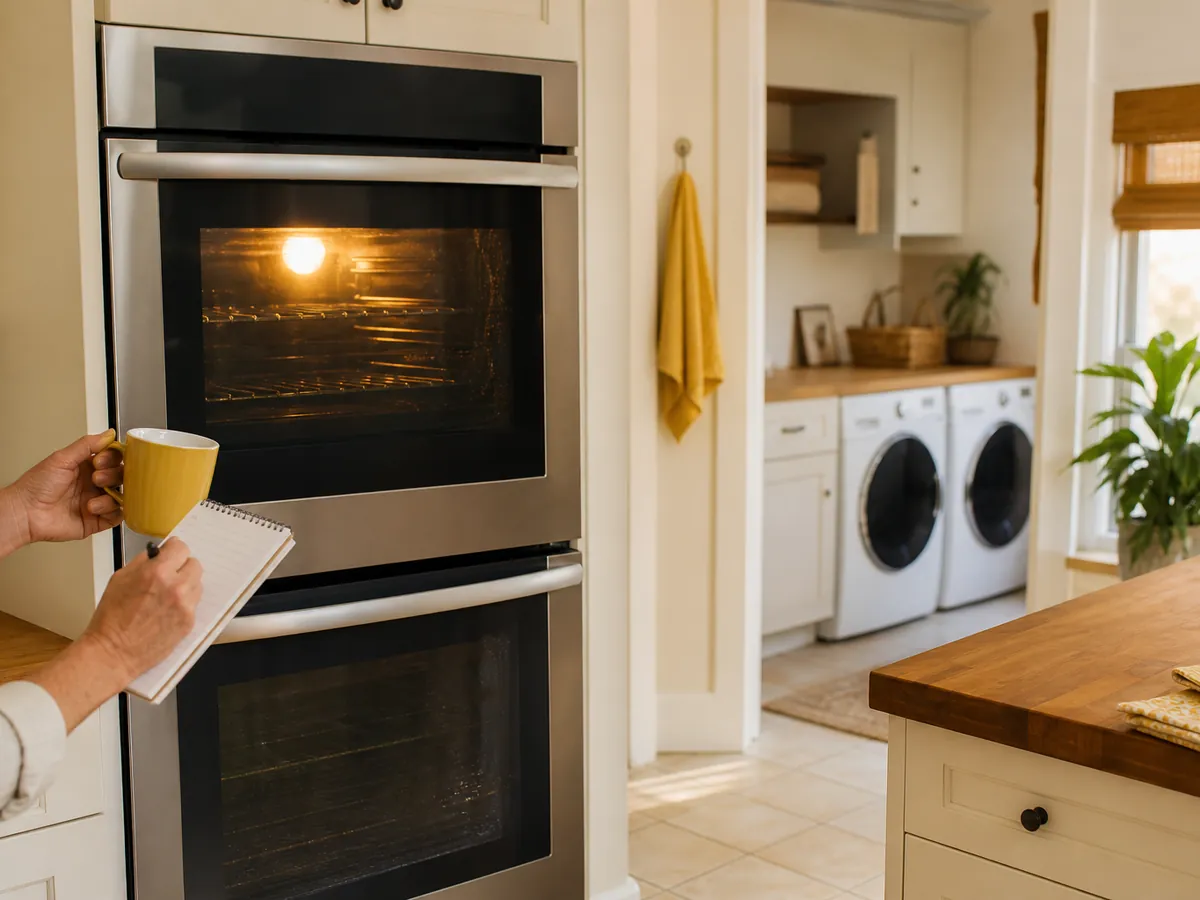
When a Whirlpool wall oven displays a code, write down exactly what the screen shows, what the oven was doing and what you had set before you reset anything. A code that clears after a reset and returns later is a pattern a technician can use, and a note taken in the moment is worth more than memory.
What should I write down?
Record the code exactly as it appears, including any letters and numbers. Note whether the oven was preheating, baking, broiling, self-cleaning or idle. Write the temperature you set, how long it had been running and whether the code appeared with a beep or a locked door. Take a clear photo of the display with your phone. Add the model and serial number from the label on the door frame or the side of the cavity.
If the oven has a second cavity, say which one was in use. The two cavities are separate, and the code may belong to one of them.
How do I reset safely?
Let the oven cool. Press the cancel or off control and see whether the code clears. If it stays, switch off the breaker for the oven, wait a minute and switch it back on. That is a power reset, and the use-and-care guide may describe it. Do not reset over and over, and do not hold buttons in combinations you have found online, since some combinations enter service modes. If the code comes back, stop and call us.
Does every code mean a broken part?
No. Some codes report a door that was left open, a locked latch after a self-clean or a power interruption. Others point to a sensor reading outside its range, a stuck key on the touchpad or a heating element that is not drawing current. We read the code against the manual for your model and then test the circuit with a meter, because the same code can have more than one cause.
What if the oven is locked after a cleaning cycle?
The door stays locked until the cavity cools. Wait for the time given in the guide. Do not force the latch or use tools to open it. If it stays locked after the oven has cooled and power has been reset, the lock motor or switch may need replacement.
What does a technician do with the information?
We read the code against the service information for your model, and we ask what you were doing when it appeared. Then we test the circuits that the code could involve with a meter, such as the sensor, the element, the latch and the board outputs. A well-kept note lets us arrive with the likely parts, which can save a second trip. It also helps us separate a one-time glitch from a pattern, and that decides whether a part has failed or the oven just needs a reset.
You receive the cause in plain language and the price in writing before any part is ordered.
How can I avoid false alarms?
Keep the cavity clean, since spilled food around the sensor or the door latch can trigger codes. Do not cover the oven floor or the racks with foil in a way the guide warns against, because it blocks airflow and heat. Use the control as the guide describes and avoid pressing buttons in rapid sequence. Surge protection helps the control board, and a code after a storm often points to a power event rather than a failed part.
If your oven is a combination model with a microwave or a warming drawer above or below it, mention that as well. Those share a cabinet and sometimes a circuit, and a code on one unit can come from a neighbor. We make a point of checking the whole installation when the model is a stack, so that a repair on one part does not leave the real cause behind. A clear record from you makes that process quicker.
| What you saw | What to record | What you can do | What we do |
|---|---|---|---|
| Code with a beep during preheat | Code, set temperature, time | Cool the oven and reset once | Test sensor and element |
| Code during self-clean | Code, lock state, time into the cycle | Wait for cooldown | Test latch and lock motor |
| Blank or frozen display | When it began, any storm | Check breaker | Test board and power supply |
| Code that clears and returns | Dates and times | Keep a log | Find the intermittent part |
Frequently asked questions
Can a power surge cause a code?
Yes. Lightning and grid surges can upset or damage the control. Tell us if a storm came before the code appeared.
Is it safe to keep baking with a code showing?
If the oven works normally and the code is only a reminder, it may be fine. If the code appears with poor heating or odd smells, stop using it.
Where is the model number?
Look at the door frame, along the side of the oven cavity or on the rear of the unit. A photo of it helps us order the right part.
Do you work on double ovens?
Yes. We test each cavity separately, and the control that serves both.